If your clinic gives an injection, dresses a wound or extracts a tooth, it makes biomedical waste, and the Bio-Medical Waste Management Rules, 2016 apply to it. That is true for a one-room chamber with no beds as much as for a nursing home. This guide sets out what the biomedical waste rules for clinic owners actually say about authorisation (what most doctors call the "biomedical waste certificate"), the four colour codes, your tie-up with a CBWTF, and the registers and annual report, with the portal for each state board we could verify.
Medical review in progress. This guide is being reviewed by a doctor and will be updated after that review. It quotes the rules; it is not clinical or legal advice.
Information as of 25 October 2026.
Which rules apply in 2026
The principal rules are the Bio-Medical Waste Management Rules, 2016, notified by the Ministry of Environment, Forest and Climate Change as G.S.R. 343(E) on 28 March 2016. They have been amended four times:
| Amendment | Notification | What changed (short) |
|---|---|---|
| 2018 | G.S.R. 234(E), 16 March 2018 | Chlorinated plastic bags and gloves to be phased out by 27 March 2019; "routine mask and gown" added to yellow; blue category containers redefined; liquid waste notes, including one for non-bedded occupiers |
| 2019 | G.S.R. 129(E), 19 February 2019 | Daily register and website display (rule 4(n)) and website annual report (rule 4(p)) now worded for bedded health care facilities |
| 2019 (second) | G.S.R. 360(E), 10 May 2019 | Clarifies that urine bags, effluent bags, abdominal bags and chest drainage bags are not "chlorinated plastic bags" |
| 2026 | G.S.R. 293(E), 17 April 2026 | Adds Ayush to the State Advisory Committee and the District Level Monitoring Committee |
As of 25 October 2026, we found no notification replacing the 2016 Rules. The 2026 amendment changes only committee membership; it does not change authorisation, colour codes or clinic duties.
Do you need authorisation? Yes, whatever the quantity
The rules define an "occupier" as the person with administrative control over the premises generating bio-medical waste, and the list includes a clinic and dispensary "irrespective of their system of medicine" (rule 3(m)). So a solo allopathic, dental, Ayurveda or homoeopathy clinic is an occupier if it generates biomedical waste.
Rule 10 says:
"Every occupier or operator handling bio-medical waste, irrespective of the quantity shall make an application in Form II to the prescribed authority i.e. State Pollution Control Board and Pollution Control Committee, as the case may be, for grant of authorisation..."
And for clinics without beds, rule 10(1) says:
"The authorisation shall be one time for non-bedded occupiers and the authorisation in such cases shall be deemed to have been granted, if not objected by the prescribed authority within a period of ninety days from the date of receipt of duly completed application along with such necessary documents."
Our reading: a bedless OPD clinic applies once in Form II, and does not renew on a cycle the way bedded facilities do. "Deemed granted" after 90 days applies only to a duly completed application, so keep your submission receipt. If you later change what you generate or how you dispose of it, rule 10(4) asks for a fresh Form II. Fees and any state-specific exemptions are set by your board, not by the central rules.
The four colour codes (the "hospital dustbin colour code")
Schedule I, Part 1 of the 2016 Rules (as amended in 2018) sets the categories. The table below keeps to the rules' own words for the waste a small OPD or dental clinic is most likely to make.
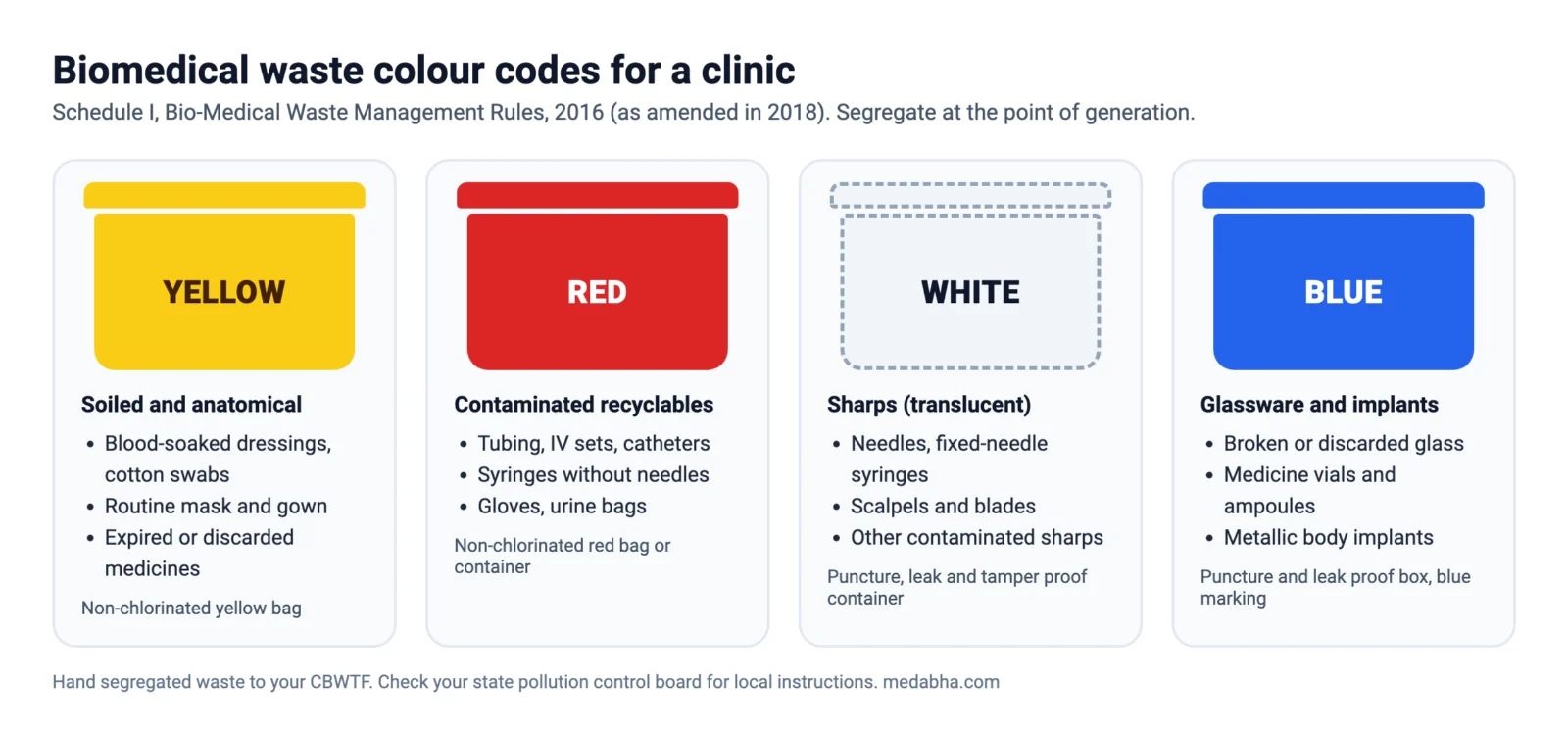
| Colour | What goes in (from Schedule I) | Bag or container (from Schedule I) |
|---|---|---|
| Yellow | Human anatomical waste; soiled waste: "items contaminated with blood, body fluids like dressings, plaster casts, cotton swabs"; expired or discarded medicines; chemical waste; discarded linen contaminated with blood or body fluid, routine mask and gown | Yellow coloured non-chlorinated plastic bags (or containers for medicines and chemicals) |
| Red | Contaminated waste (recyclable): "tubing, bottles, intravenous tubes and sets, catheters, urine bags, syringes (without needles and fixed needle syringes) and vaccutainers with their needles cut) and gloves" | Red coloured non-chlorinated plastic bags or containers |
| White (translucent) | Waste sharps including metals: "Needles, syringes with fixed needles, needles from needle tip cutter or burner, scalpels, blades, or any other contaminated sharp object that may cause puncture and cuts" | Puncture proof, leak proof, tamper proof containers |
| Blue | Glassware: "Broken or discarded and contaminated glass including medicine vials and ampoules except those contaminated with cytotoxic wastes"; metallic body implants | "Puncture proof and leak proof boxes or containers with blue colored marking" (2018 wording) |
A few rules sit around the table:
- Waste must be segregated "at the point of generation" (rule 8(2)), and untreated biomedical waste must not be mixed with other waste (rule 8(1)).
- Bags and containers must be labelled as in Schedule IV (rule 8(3)).
- Untreated human anatomical waste and soiled waste must not be stored beyond 48 hours (rule 8(7)).
- Syringes "should be either mutilated or needles should be cut and or stored in tamper proof, leak proof and puncture proof containers" (Schedule I, Part 2, item 11).
- Ordinary non-biomedical waste goes under the solid waste rules (rule 4(e)), and treated biomedical waste must not be given with municipal solid waste (rule 4(f)).
Your CBWTF: hand over, do not treat on site
A CBWTF (Common Bio-medical Waste Treatment Facility) is the licensed operator that collects and treats waste from clinics in your area. The rules say:
- "Occupier shall hand over segregated waste as per the Schedule-I to common bio-medical waste treatment facility for treatment, processing and final disposal" (rule 7(2)).
- No occupier shall set up on-site treatment if a CBWTF service is available within 75 km (rule 7(3)).
- You must keep a safe, ventilated and secured place in the premises to store segregated waste until it goes to the CBWTF (rule 4(b)).
- If the CBWTF does not collect on time, you must inform the board immediately (rule 4(q)).
- The CBWTF must collect on holidays too (rule 5(o)) and may supply non-chlorinated coloured bags on a chargeable basis (rule 5(n)).
The central rules do not use the word "agreement". In practice, boards can ask for proof of your tie-up with a CBWTF with the application. West Bengal's step-by-step guide, for example, asks you to upload the CBMWTF agreement. Keep the current agreement or membership certificate on file.
Registers, records and the annual report
| Duty | What the rule says | Who it applies to (our reading) |
|---|---|---|
| Annual report | "Every occupier ... shall submit an annual report to the prescribed authority in Form-IV, on or before the 30th June of every year" (rule 13(1)) | Every occupier, bedded or not |
| Records for 5 years | Records of generation, collection, storage, transport, treatment and disposal "for a period of five years" (rule 14(1)), open to inspection (rule 14(2)) | Every authorised person |
| Daily BMW register and monthly website display | Rule 4(n), as substituted in 2019: "in case of all bedded health care units" | Bedded facilities. A bedless clinic is not named here, but rule 14 records still apply |
| Annual report on your own website | Rule 4(p), as substituted in 2019: "in case of all bedded health care facilities (any number of beds)" | Bedded facilities |
| Training and immunisation | Train staff at induction and at least once a year (rule 4(g)); immunise against Hepatitis B and Tetanus (rule 4(h)) | Every occupier |
| Accident reporting | Major accidents in Form I (rule 4(o), rule 15) | Every occupier |
| Bar code | Bar code system for bags or containers sent out of the premises (rule 4(i), rule 8(4)) | Every occupier; ask your CBWTF how it labels bags |
| Liquid waste | "Non-bedded occupiers shall dispose infectious liquid wastes only after treatment by disinfection as per Schedule-II (6)" (2018 note in Schedule II) | Bedless clinics |
Rule 4(r) also says establishments with fewer than thirty beds "shall designate a qualified person to review and monitor the activities relating to bio-medical waste management ... and submit the annual report". Whether a zero-bed clinic falls under this wording is our reading only: in a solo clinic the doctor usually is that person.
The five-year records in rule 14 are waste records, not patient records. If you keep visits in clinic management software, keep the biomedical waste register, CBWTF hand-over slips and the Form IV copy separately, in one file you can show an inspector.
Medabha handles your clinical paperwork: digital prescriptions and visit records, with prescriptions shared with patients on WhatsApp.
For dental clinics
The rules do not have a dental chapter. What they say that matters most in a dental chair:
- Sharps: needles, blades and "any other contaminated sharp object that may cause puncture and cuts" go in the white translucent container.
- Soiled items: cotton and dressings contaminated with blood or body fluids go in yellow.
- Glass: local anaesthetic cartridges and other contaminated glass vials and ampoules fall under the blue glassware entry.
- Mercury and amalgam: the rules say only that "the handling and disposal of all the mercury waste and lead waste shall be in accordance with the respective rules and regulations" (rule 7(11)). They do not set a colour for amalgam. Ask your state board or CBWTF how they want it handed over.
- Extracted teeth and X-ray waste: we found no specific entry. Silver X-ray film developing liquid is listed under chemical liquid waste. Check with your board for the rest.
State boards: where to apply
The prescribed authority is your State Pollution Control Board, or the Pollution Control Committee in a Union Territory (rule 9(1)). The steps below are from each board's own pages as of 25 October 2026. Portals change, so confirm on the board's site.
| State | Board | Portal | Verified steps |
|---|---|---|---|
| Gujarat | Gujarat Pollution Control Board (GPCB) | XGN module, linked from gpcb.gujarat.gov.in | Check with your board for current steps and fee |
| Maharashtra | Maharashtra Pollution Control Board (MPCB) | ecmpcb.in, service "BMW Authorization (/Combined Consent)"; new users register once on the MAITRI portal. MPCB also published a notice for online BMW authorisation of non-bedded clinics and dispensaries (13 November 2017) | Check with your board for current fee |
| Karnataka | Karnataka State Pollution Control Board (KSPCB) | XGN / OCMMS (krocmms.nic.in) | Check with your board for current steps |
| West Bengal | West Bengal Pollution Control Board (WBPCB) | OCMMS at wbocmms.nic.in; new users register through Silpasathi | Board's step-by-step guide: log in, Bio-Medical Authorisation, Apply for BMW, fill waste generation and management details, upload CBMWTF agreement and documents, submit |
| Kerala | Kerala State Pollution Control Board | Checklist page (general checklist for integrated consent/authorisation for hospitals and clinics, 18 May 2023) | Check with your board for the online portal and steps |
| Delhi | Delhi Pollution Control Committee (DPCC) | DPCC's OCMMS notice says new applications for consent and authorisation now go through the CPCB UCAMS portal; OCMMS no longer accepts them | Check with DPCC for fee and documents |
| Tamil Nadu | Tamil Nadu Pollution Control Board (TNPCB) | OCMMS at ocmms.tn.gov.in | Board's instructions: register once, log in, apply for authorisation, Bio-Medical Waste, fill the general, waste and document tabs. Check with your board for documents |
For any other state, search your board's site for "bio-medical waste authorisation" or ask its regional office.
If you are in Gujarat, biomedical waste also shows up in your clinical establishment registration: see the documents checklist in our Gujarat clinical establishment registration guide. In West Bengal, read this with our guide to the chamber clinical establishment licence.
What is still unclear
- Whether your board charges a fee for one-time authorisation, and how much. The central rules do not set one.
- Whether a zero-bed clinic counts under the "less than thirty beds" wording in rule 4(r).
- How "deemed granted" after 90 days is recorded by each board, and whether your clinical establishment authority will accept a deemed authorisation as proof.
- How each board wants amalgam and extracted teeth handed over.
Your state board's regional office and your CBWTF are the right people to ask.
Sources
- Bio-Medical Waste Management Rules, 2016, G.S.R. 343(E), 28 March 2016, CPCB copy
- CPCB rules page listing amendments of 16.03.2018, 19.02.2019, 10.05.2019 and 17.04.2026
- Bio-Medical Waste Management (Amendment) Rules, 2018, G.S.R. 234(E)
- Bio-Medical Waste Management (Amendment) Rules, 2019, G.S.R. 129(E)
- Bio-Medical Waste Management (Second Amendment) Rules, 2019, G.S.R. 360(E)
- Bio-Medical Waste Management (Amendment) Rules, 2026, G.S.R. 293(E), CPCB copy
- State board pages as named in the table above
This is a general guide, not legal advice. Check the rules and your state board's portal, or speak to the board's regional office, for anything specific to your clinic.
Information as of 25 October 2026.
Frequently asked questions
Does a small OPD clinic with no beds need biomedical waste authorisation?
Rule 10 of the Bio-Medical Waste Management Rules, 2016 says every occupier handling bio-medical waste, irrespective of the quantity, shall apply in Form II to the State Pollution Control Board or Pollution Control Committee. For non-bedded occupiers the authorisation is one time, and it is deemed granted if the board does not object within ninety days of a duly completed application.
What are the four biomedical waste colour codes?
Schedule I of the 2016 Rules sets four categories: yellow (anatomical waste, soiled waste such as dressings and cotton swabs, discarded medicines, chemical waste), red (contaminated recyclable items such as tubing, IV sets, catheters, syringes without needles and gloves), white translucent (sharps, in puncture proof, leak proof, tamper proof containers) and blue (glassware such as broken vials and ampoules, and metallic body implants, in boxes with blue marking).
What is the last date for the biomedical waste annual report?
Rule 13(1) says every occupier shall submit an annual report to the prescribed authority in Form IV on or before 30 June of every year. Your state board may have its own online return for this, so check its portal.
Do the biomedical waste rules have a separate rule for amalgam in dental clinics?
Not that we found. Rule 7(11) says the handling and disposal of all mercury waste shall be in accordance with the respective rules and regulations. Ask your state board or CBWTF how they want amalgam waste handed over.
Try Medabha in your own clinic
AI medical scribe, WhatsApp prescriptions, specialty charts and a built-in clinic website, set up in minutes.
Start 14-day free trial Prefer a walkthrough? Book a demoNo card needed.
This article is general information about clinic software and documentation workflows, not medical, legal or regulatory advice. Check current requirements with the relevant authority before making compliance decisions.