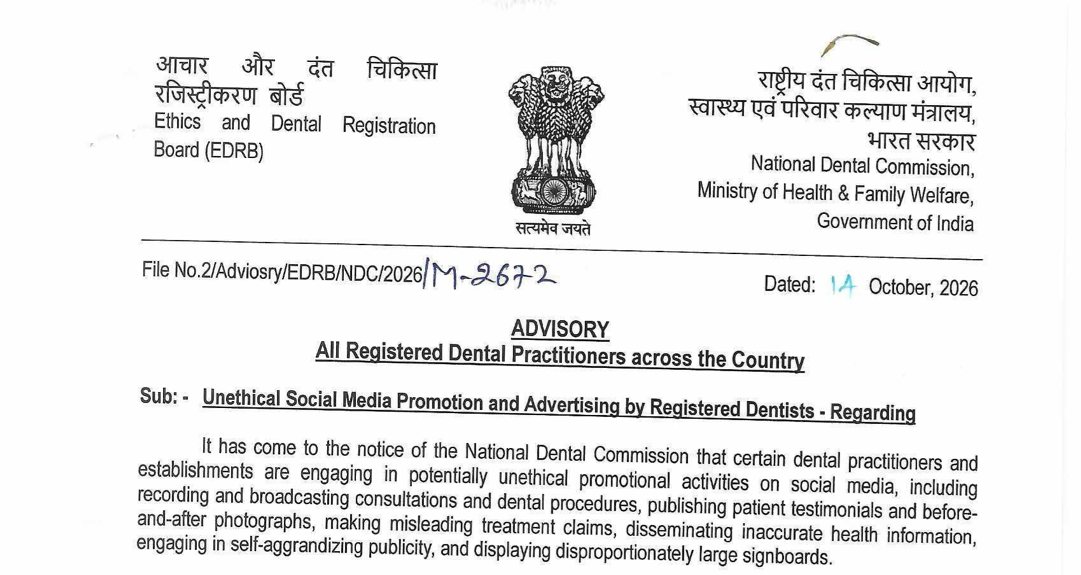
On 14 October 2026, the Ethics and Dental Registration Board (EDRB) of the National Dental Commission issued an advisory to "All Registered Dental Practitioners across the Country". Its subject is "Unethical Social Media Promotion and Advertising by Registered Dentists". It is on the NDC public notices page as a two-page PDF, in English and Hindi, signed by Lt. Gen. (Retd.) Tapas Kumar Bandyopadhyay, Member, EDRB. The advisory PDF is the text this guide follows.
If you run a single-chair clinic, you probably have an Instagram page, a Google Business Profile, a website someone built for you, and a board outside. The advisory touches all four. This guide sets out what it says, what the three clauses it cites actually say, and what to check today.
This is a general guide, not legal advice. Where we interpret the advisory or the Code, we say it is our reading. A named dentist has not signed this page off yet.
What the advisory says
The advisory has six short paragraphs. The first lists what the Commission has noticed. In its words, certain dental practitioners and establishments are "engaging in potentially unethical promotional activities on social media, including":
- "recording and broadcasting consultations and dental procedures"
- "publishing patient testimonials and before-and-after photographs"
- "making misleading treatment claims"
- "disseminating inaccurate health information"
- "engaging in self-aggrandizing publicity"
- "displaying disproportionately large signboards"
The second paragraph points to "the applicable statutory provisions and Chapter VI (Unethical Acts), Clauses 8.1, 8.2 and 8.3 of the Revised Dentists (Code of Ethics) Regulations, 2014". It advises dentists to adhere to professional ethics "governing advertising, patient solicitation, confidentiality, publicity and signage".
The third paragraph is the warning: "Any established violation may invite appropriate disciplinary action, including issuance of a show-cause notice, suspension or removal from the State and National Register of Dentists, as permissible under applicable law."
The fifth says it "shall take effect immediately, subject to the statutory powers of the issuing authority."
The advisory creates no new rule. It tells dentists that the 2014 Code applies to what they post online.
What clauses 8.1, 8.2 and 8.3 say
We read the clauses in the Revised Dentists (Code of Ethics) Regulations, 2014 as published on the Dental Council of India website. Chapter 6, "Unethical Acts" (the advisory calls it Chapter VI), applies to "all registered practitioners whether they are in individual private practice, attached to hospitals, teaching hospitals or employed by others".
8.1 Advertisement. The clause opens by saying "A Dentist or a group of Dentists may advertise provided that they maintain decorum". It then lists nine things that are unethical. The ones a solo clinic is most likely to meet:
- 8.1.1: "demeaning solicitation and false promises through advertisements or direct marketing".
- 8.1.2: promotion that cold-targets vulnerable groups, including "camps and other promotional activity in schools, colleges, old age homes and distributing handbills, claim vouchers". Registered charities giving fully free care are exempted.
- 8.1.4: employing "any agent or canvasser for the purpose of obtaining patients in a manner that is commercial".
- 8.1.5: "any disproportionately large sign", other than one that "may reasonably be required to indicate to persons seeking the exact location of, and entrance to, the premises".
- 8.1.6: letting your name be used for "tooth paste, tooth brush, tooth powder, mouth washes" and similar products.
- 8.1.7: publishing your opinion on a procedure or equipment in lay media "except when validated or supported by evidence based studies".
- 8.1.8: "surrogate advertisements in the garb of educating the public through TV programs, magazines or periodicals". Public information given in good faith "should not carry addresses telephone numbers, e-mail addresses etc." of the dentist or clinic.
8.2 Soliciting. A dentist "shall not make use of himself (or his name) as subject of any form or manner of advertising or publicity" that invites attention to "his professional position, skill, qualification, achievements, attainments, specialties, appointments, associations, affiliations or honors" or that "would ordinarily result in his self-aggrandizement". The same clause says a dentist shall not "boast of cases, operations, cures or remedies or permit the publication of report thereof through any mode."
Clause 8.2 also lists what is not a problem: formal announcements on starting practice, changing address, absence and return, and new equipment or services "without boastful claims of being the 'best' or 'first'" (8.2.1 to 8.2.7). Directory and internet listings serve as public information, but "any claim to superiority or special skills over others will be construed as unethical practice" (8.2.8). And under 8.2.9, websites "where all information is factual will not be construed as unethical practice", and "can also carry details of treatment facilities available and the fees for the same".
8.3 Publicity and Signage.
- 8.3.1: a self photograph "in the letter head or on sign board" is "self-advertisement". Sketches, diagrams and pictures of the human system are fine.
- 8.3.2: any sign beyond what is needed to show the location and entrance is unethical. That includes words that "trivialize the dignity of the profession", notices at premises where you do not practise, "show cases, or flickering light signs", any matter on the sign other than your name and qualifications (8.3.2.1), and a board on a chemist's shop or where you do not reside or work (8.3.2.2).
- 8.3.3: no specialist claim on the name board or stationery "unless he has a special qualification (which is recognized by the Council) in that Specialty".
Two drafting points to know if you read the PDF yourself. The text refers back to "Revised Dentists Code of Ethics Regulations, 2012" in places, and 8.2 mentions provisions "8.2.1 to 8.2.10", though the published text stops at 8.2.9.
Where each item in the advisory sits in the Code (our reading)
The 2014 Code was written before reels, and it does not use the words "social media", "testimonial" or "before-and-after". This mapping is our reading of which clause each item in the advisory most likely rests on:
| Advisory names | Closest text in the 2014 Code |
|---|---|
| Recording and broadcasting consultations and procedures | 8.2 "boast of cases, operations"; confidentiality (4.2) |
| Patient testimonials | 8.2 publicity that invites attention to your skill |
| Before-and-after photographs | 8.2 "boast of cases, operations, cures or remedies" |
| Misleading treatment claims | 8.1.1 "false promises"; 8.2.9 "not factual and therefore misleading" |
| Inaccurate health information | 8.1.7 opinions only when evidence based |
| Self-aggrandizing publicity | 8.2 "self-aggrandizement" |
| Disproportionately large signboards | 8.1.5 and 8.3.2 |
Confidentiality is named in the advisory but sits in clause 4.2 of the Code, outside Chapter 6. It says confidences entrusted by patients "should never be revealed unless such a revelation is required by the laws of the State."
A takedown checklist for a solo dental clinic
Set aside an hour. Each line below is our reading of the advisory and the clauses above, not an official list.
Instagram, Facebook and YouTube
- Remove videos filmed during consultations or procedures, including "watch this RCT" clips, scaling reels and chairside talking videos where a patient can be seen or heard.
- Remove before-and-after posts, carousels and highlights, including smile makeover and aligner "results" posts.
- Remove patient thank-you videos, review screenshots and DMs reposted as stories.
- Remove treatment claims you cannot prove: "painless root canal", "smile makeover in one day", "permanent results", "guaranteed". If it promises an outcome, treat it as a claim.
- Check educational reels. Health information has to be accurate, and 8.1.7 ties opinions on procedures to evidence. 8.1.8 also says public information should not carry the clinic's address, phone or email. It names TV, magazines and periodicals, but our reading is that an educational reel ending with "call us on 98xxx" is close enough to be worth changing.
- Remove posts about awards, rankings and "celebrity dentist" coverage, and any brand promotion for toothpaste, mouthwash or similar products (8.1.6).
Google Business Profile
- Business name: your clinic's name only. "Best Dental Clinic in Salt Lake" in the name or description is a claim to superiority (8.2.8).
- Photos: remove before-and-after and treatment-result photos you uploaded.
- Reviews: the advisory does not mention Google reviews. Our cautious reading is not to repost them on Instagram or your website, since that turns them into testimonials you published. When you reply, do not confirm the person was your patient or mention their treatment (4.2).
Clinic website
- Keep the factual parts: name, qualifications, registration, treatments offered, fees, timings, address (8.2.9).
- Remove testimonial sections, star ratings, before-and-after galleries and "results" photo captions.
- Remove "best", "No. 1", "most advanced" and other claims nobody can check.
- If you list a speciality, 8.3.3 ties a specialist claim to a recognised qualification in that speciality. It names the name board and stationery; our reading is to apply the same test to your website.
- If an agency or template filled in sample photos or text, read every caption. A stock photo captioned as a result reads like an outcome photo.
Signboard, letterhead and prescription pad
- No photo of yourself on the board or letterhead (8.3.1).
- Board contents: name and qualifications (8.3.2.1). No flickering lights or show cases (8.3.2.1).
- Remove boards at places you do not practise, and any board on a chemist's shop (8.3.2.1, 8.3.2.2).
- Size: see the next section.
WhatsApp and outreach
- Stop broadcast offers, discount coupons and "free check-up camp" forwards. 8.1.2 names handbills, claim vouchers and promotional camps in schools, colleges and old age homes.
- Do not forward patients' thank-you messages to groups or statuses.
- If you pay anyone per patient brought in, read 8.1.4 on agents and canvassers with your lawyer.
- Sending your own patient their prescription, after-care advice or next sitting date is care, not advertising. That is our reading; the advisory does not discuss it.
What the advisory does not define
"Disproportionately large". Neither the advisory nor the Code gives a size. The test in 8.1.5 and 8.3.2 is what "may reasonably be required to indicate to persons seeking the exact location of, and entrance to, the premises". Our reading: a board that helps someone find your door is fine; a hoarding visible from the next junction, or boards away from your clinic, is what the clause is aimed at.
"Self-aggrandizing publicity". Clause 8.2 lists qualification, specialties and honours among things you should not use to invite attention to yourself, yet 8.2.9 says a factual website is not unethical. Our reading: stating your BDS or MDS on your website is factual, while a post celebrating your award or ranking is publicity.
Recording for records. The advisory names "recording and broadcasting". It does not say that taking clinical photographs for the patient's record is unethical. Our reading is that the risk starts when a recording is published.
Which law sits behind it. The 2014 Code was made under the Dentists Act, 1948. The advisory refers to "applicable statutory provisions" and cites the 2014 Code. How the disciplinary process now runs between the NDC and State Dental Councils is a question for your lawyer.
If you also work with an MBBS colleague
Medical doctors have a separate rulebook: the NMC's 6 October 2026 guidelines. If your clinic page or Instagram account names a doctor registered with a State Medical Council, see our NMC advertising guidelines self-check for their side.
If you use Medabha for your clinic website
Here is what Medabha's clinic website does today, and what it does not.
Testimonials. The website does not show a testimonials or reviews section, and the AI writer will not write reviews. Medabha does not send a post-visit WhatsApp asking for a Google review.
Before-and-after layout. This layout was retired in early October. Images saved in it are hidden on the public site and in the preview. The editor tells you: "Before-and-after images are hidden. Delete them or replace them with clinic photos." The files stay in your account until you delete them.
Gallery. The gallery takes any JPG, PNG or WebP photo you upload, up to 12. Nothing checks what a photo shows, so the choice of pictures is yours. Captions are included in the wording check below.
Wording check. When you save or publish, Medabha scans your text, including photo captions, for words such as "best", "No. 1", "painless", "guaranteed" and "discount", and also "smile makeover", "smile design", "Hollywood smile", "instant whitening", "before and after" and "smile results". It shows a reminder and never blocks saving. On a dental site the reminder names the dentists' Code of Ethics and the NDC's 14 October 2026 advisory. On other sites it names NMC rules. A stock photo in the smile studio template is captioned "Dental care". If a saved caption is exactly "Smile results", the public page shows "Dental care".
Letterhead. The printed prescription header shows your clinic name, an optional line you type, address and phone, and GSTIN when you have switched that on. It has no photo field. Check the line you type against 8.2 and 8.3.
For the rest of what a dental clinic website needs, see our clinic website guide, dental clinic software and clinic management software, which includes the website builder.
What to do this week
- Go through the checklist above for Instagram, Facebook, YouTube, your Google profile, website, board and WhatsApp.
- Archive or delete what matches the advisory's list. Keep a dated note of what you removed.
- Tell whoever posts for you, whether an agency, staff member or relative, about the advisory.
- If you receive a show-cause notice, reply through a lawyer and within the time it gives.
- Watch the NDC public notices page for clarifications. We will update this page if the NDC issues any.
Coverage so far: Medical Dialogues reported the advisory on 15 October and Ei Samay on 16 October. This guide is based on the advisory PDF itself.
This is a general guide, not legal advice. Check the advisory, the 2014 Code and your State Dental Council for anything specific to your practice. Information as of 18 October 2026.
Frequently asked questions
Does the NDC advisory stop dentists from using Instagram or YouTube?
No. It does not mention any platform by name and does not tell dentists to close their accounts. It names practices: recording and broadcasting consultations and procedures, patient testimonials, before-and-after photographs, misleading treatment claims, inaccurate health information, self-aggrandizing publicity and disproportionately large signboards. Clause 8.1 of the 2014 Code says a dentist may advertise provided decorum is maintained. Our reading is that the account can stay, and the posts that match the advisory's list should go.
Can I post before-and-after photos if the patient has given consent?
The advisory names publishing before-and-after photographs and says nothing about consent. Clause 8.2 of the 2014 Code also says a dentist shall not boast of cases, operations, cures or remedies. Our reading is that written consent does not take a before-and-after post out of the advisory's list, so the cautious step is to take such posts down and keep clinical photos in the patient record only.
Can my clinic website still show treatments and fees?
Yes. Clause 8.2.9 says a website about a dentist or dental clinic where all information is factual will not be construed as unethical, and that websites can carry details of treatment facilities and the fees for them. What the clause rules out is claims or statements that are not factual and therefore misleading.
What happens if a complaint is made about my posts?
The advisory says any established violation may invite disciplinary action, including a show-cause notice, suspension or removal from the State and National Register of Dentists, as permissible under applicable law. It does not set out graded penalties. Under Chapter 7 of the 2014 Code, a complaint goes to the appropriate Dental Council, which holds an enquiry and gives the dentist a chance to be heard in person or by pleader. If you receive a notice, speak to a lawyer.
Try Medabha in your own clinic
AI medical scribe, WhatsApp prescriptions, specialty charts and a built-in clinic website, set up in minutes.
Start 14-day free trial Prefer a walkthrough? Book a demoNo card needed.
This article is general information about clinic software and documentation workflows, not medical, legal or regulatory advice. Check current requirements with the relevant authority before making compliance decisions.